
Italian ceramics, or Italian pottery, have been in my life for quite a long time: I collect them, I read about them, I sell them.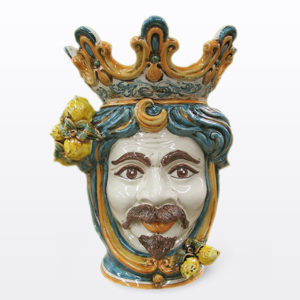
In Italian, when I say ceramica, everybody understands what I mean. On the contrary, when I talk with one of my American friends, I’m always uncertain: should I say Italian pottery, Italian ceramics or Italian majolica?
In order to do away with any doubt, I did some research. I did learn quite a lot on the subject, and I would love to share my findings with you.
Let’s start with technicalities.
Here is a short review of the definition of the words Ceramics, Pottery and Majolica.
Once we know exactly what we are talking about, we will define what they really mean to people.
Ceramics
Ceramic is the most general term. It is derived from the Greek word keramos, meaning “clay”.
Historically, ceramics were prepared by shaping clay, decorating it, often glazing and firing it at high temperatures in a kiln. However, this definition has changed. The term ceramics now refers to a diverse group of materials, including types of cement and glass. While all are fired at high temperatures, clay is no longer a key component of ceramics.
That is why, nowadays, the category ceramics technically includes both pottery and porcelain, which, with their standard formulas, have come to popularly represent quality grades.
Pottery
Pottery is an ornamental or functional ware shaped from moist clay and hardened by heat. The type of clay used and the temperature at which it is fired give pottery a different appearance and strength.
There are three major pottery types.
-
-
- Earthenware
It is also known as bisque or biscuit, and it is fired at low temperatures – 1800° to 2100° Fahrenheit. It is usually reddish or white. Due to its high porosity, earthenware must usually be glazed to enable it to hold water or any liquid.
Earthenware pieces have been found that date back to 1400-1200 BC, making this craft the oldest pottery in history. - Stoneware
It is made of a heavier clay mixture, which can be fired at much higher temperatures – 2200° to 2400° Fahrenheit. It is dense, impermeable and hard enough to resist scratching by a steel point. It’s brownish gray, and it can be used both blazed and unglazed. Ideal for cooking and baking. - Porcelain
It’s made of a specific clay, containing kaolinite, and it is fired at high temperatures – 2200° to 2500° Fahrenheit. It is hard, impermeable (even before glazing), white, translucent and resonant.
- Earthenware
-
Majolica
Majolica – also spelled Maiolica – is the beautiful ware prepared by tin-glazing earthenware and firing it a second time.
After the first firing, the bisque is dipped into a bath of fast-drying liquid glaze. When dry, the glazed piece is ready to be hand-painted. A final firing at 1690° Fahrenheit will make the glaze interact with the metal oxides used by the painter to create the deep and brilliant translucent colors specific to majolica.
This technique originated in the Middle East in the 9th century. By the 13th century, majolica ware was imported into Italy through the Isle of Majorca, the headquarters of the trade between Spain and Italy. The Italians called it Maiolica, erroneously thinking it was made in Majorca. They were fascinated by this new way of making ceramics and soon started to copy the process, adapting it to their own creativity and traditions. The rise of Italian majolica in Europe was fast and reached its peak of artistic quality throughout central Italy during the Renaissance – late 15th and early 16th centuries.
Nowadays, in English, the word Majolica is used to refer to ceramic ware in the stylistic tradition of the Italian Renaissance.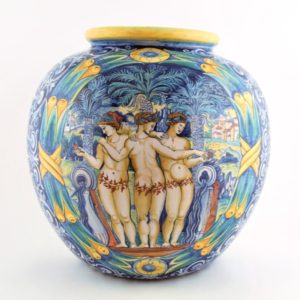
Now I know that I collect and sell pottery, specifically earthenware, mostly Italian majolica.
The original question is still unanswered, though. I still do not know what I should call my beloved ware when talking to my American friends.
Having rejected the use of Earthenware, because the word is by far too technical, I tested using the term Italian majolica. Only museum staff or experts understood what I meant, and many of them figured I was talking about istoriato Renaissance ware, while I had in mind modern Italian majolica pieces.
As the next step, I tested the phrase Italian pottery. The result was good, everybody knew I was talking about clay ware in the shape of an Italian bowl, an Italian vase or an Italian dinnerware set. I was not satisfied, though. Pottery is any kind of ware shaped from moist clay and hardened by heat. Pottery can be used for a $20 chicken cooking pot as well as a $2000 Italian istoriato wall plate.
How could I convey both the technical process behind Italian pottery as well as its unique quality and beauty?
I tested the term Italian ceramics, and it worked perfectly. Exploring my Customers’ and friends’ reactions, I found out that it actually conveyed high quality and included both dinnerware and ornamental ware.
There is a historical explanation for this.
 Although “Ceramics” is – nowadays and in purely technical language and a more general term than pottery, it has been used for more than 3000 years in the countries where this craft was born and evolved into a form of art.
Italy is one of those countries: we proudly handcrafted some of the finest ceramics in the history of this art. Italian ceramics include the Etruscan “bucchero”, the Renaissance majolica and lusterware, the Baroque tiles from Sicily, the “zaffera” from central Italy, the contemporary clay art…
When we say Italian ceramics, we mean much more than items made of clay, earthenware or majolica. These two words embody artistic heritage, history, regional traditions, and the creativity of a people. They touch a chord in our souls. That’s probably why so many people are passionate about Italian ceramics.
Like you and me.
Article posted on Dec. 20th, 2007, updated on May 23rd, 2019
Bravo! This article is a brave attempt to clarify a rather complex subject and it did so beautifully. It is a wonderful introduction into the world of clay and glazes. But it was Tiziana’s last paragraph that contains the real value. Those words were written, as only a true collector of Italian ceramics could have crafted them-with passion. Hopefully, in time, others will join in the joy that comes from owning examples of magnificent handcrafted Italian pottery that are created by artisans who respect the traditions of the past while being able to incorporate the very best of the contemporary and the modern.
Walter
I am looking for information on cantagali..Italian pieces marked with a rooster…especially those in the Della Robbia Style. I am a small time collector but I am passionate about these beautiful blue and white pieces that so often depict religious themes. I particularly love the ones with the colorful fruit borders. I want to know how to determine the age to be sure I am not getting fakes..I look for old pieces. I have 2 very nive, very large pieces as well as a lot of smaller ones. I am currentky trying to buy a piece on e-bay but I think she is asking way too much..I would have a better idea if I know more about the marks on the back..a rooster and impressed cantagali, firenze {Italy} is what it says… . You seem so knowledgeable..I hope you can help me become more savy!
Anne Clayton
Hi, I enjoyed reading your page. I have a piece of pottery -not sure which definition it falls under- it’s a vase above 14″ tall, it was my grandparents, I think it’s from the 50’s. It has a signature on the bottom that I can’t make out and was wondering if you recognize it. It looks like M with A in the middle (or A with M in the middle) under that it is ITALY the signature is pretty large about 1 1/2″ x 1 1/2″. Does this sound familiar – I can send a picture if that would help. Can you refer me to someone else who might recognize this signature? Any help would be greatly appreciated. Thank you
Great,the difference is well explained.
Thanks for a very informative article. Most of my finds have been American stoneware, pottery. I have recently begun work on an estate that has many Quimper, faience and Italian pieces. Most of my research on the Italian pieces leads me to new retail items. One piece in particular has a redware inside color, a blue wash on the outside, and a shiny Majolica like scene of a partridge in a pear tree and a pear on the other side. It is numbered, signed and marked Italy, along with a hallmark that has a moonshaped C with an R or P on its lower tail. It’s not as ornate as most Italian pieces…very simple and elegant look. Any ideas? Thanks again.
i have an italian ceramic vase wrapped around the bottom rounded part of vase with leather. on the bottom is italy with a rooster mark. please help no idea who and where in italy makes this type of ceramic ware. i have researched but came up with no info. thank-you
I was very interested in your article, because for my ceramics class i had to find a piece from Italy that I really like and try to make one myself, I finally chose one but I’m not quite sure what kind it is.. the color is a dark red and has grapes on it and they have either a bowl or a large urn or a platter.. If you have any idea what kind of pottery this might be it would be of great help!
Excellent site, keep up the good work
Hi , I have a handpainted vase with 3 dimentional flowers on each side of it one blue and one yellow.the only marking is the word italy handpainted in black on the bottom, I have been looking for hours now for any artical on handpainted markings of just the word italy and found absolutly nothing, if you could help that would be great or if you could write an artical on italian markings and dates even better.
I have a set of three urn type canisters that are signed and numbered with the following. 66/H.F Made in Italy Can anyone tell me anything about these ceramic pieces?
could you pls give thew differences between pottery and ceramics
Bravo sir, I am an historical archaeologist and deal with these terms on a very regular basis, but still get intensely confused in the technical language. In fact, that’s how I found your site.
I did want to make a comment in regards to your last paragraph. I had the pleasure of visiting the pottery museum in Deruta while working in Umbria and they house a vast collection of Italian ceramics going back to the Etruscan period. It is all exquisite, refined, and remarks of a culture that prizes its artistic endevours at the highest level.
i have bought a pair of candlesticks, they look like a dragon type fish, the mouth being the holder of the candle, the dragon or fish type body and tail turns back towards the head to make the holder () for the finger to fit into, this sits ontop a seashell, the halmark is that of a rooster, one blue, one brown, any information on this type candlestick would be helpfull reply to, jreuss@webtv.net.. i thank you! colors are bright, blues, greens, yellows
Firstly, I need to introduce myself. I have worked as a technician in the ceramic industry of Stoke on Trent and at a university ceramics department for 33 years. I also hold a Masters degree in History of Art and Design (specializing in Renaissance studies).
The term ‘ceramic’ refers to the material itself, when silica particles in a clay body have fused as a result of being heated. This fusing begins at around 575 degrees centigrade and is irreversible. As previously stated, the term ‘pottery’ refers to an intended domestic function of (ceramic)ware.
I would also like to draw attention to another source of confusion resulting from terminology. ‘Majolica’ is also used in the UK to refer to a low firing clear glaze established by Mintons of Stoke on Trent during the mid-nineteenth century. It was developed to give a clear finish that would not ineract with colour applied beneath it. It was marketed as ‘Majolica’ in a an attempt to borrow cultural status from italian maiolica and really has no other conection whatsoever.
Thank you very much for your valuable contribution!
Have a 4-canister set that are thin white probably ceramic, hand-painted in Italy with yellow, pink and purple flowers all with paler greenery signed by Ernestino (in cursive and haven’t confirmed the spelling need magnifying glass to confirm). The lids are the same green as the greenery. The hand-painted flowers are beautiful. On the bottom is a number that is maybe ‘fired’ into the ceramics and it’s hard to see but on the first line is either an “E” or an “8” and 3 black hand-written initials, maybe ZLS??? I believe these to be approximately 60 years old. I would like to know the value. Thank you.
forgot to add the second line on the bottom of the canister that is fired into the ceramics: F191C.
Thank you
Hi. I am looking for a specific piece of Majolica, I have a photo. I am taking a craze shot here, wondered if you would be able to help me find the manufacturer or distributor to buy one. If you send me an email, I can send the photo.
Regards, Steve
I recently received a gift and cannot identify it. It is a plate, 8-3/4 inches, Deruta Ceramiche Made in Italy. The rooster is standing on a fence and looks to be hand sketched. There is Italian handwriting all over the plate: top, right and bottom. The writing appears to be hand-done in brown. The title appears to be “Luz Campagne”? I would like to know what the plate says. Can you help?
I own a lovely 14″ hand painted glossy white rooster with red wabble and details painted with black brush strokes. It is marked with black brush strokes, Italy. Ther is a small lid on the back of the rooster. It caught my eye a few years ago. I have been unable to find one like it.
Thanks,
Marilyn Moss
I came across this vase it is majolica I am pretty sure, the person that I bought it from said it was her grandmothers, it is 14inches high hand painted, a redware inside color with 5 different colors on it, the base is green a little higher is red, the middle which is 6inches high is blue and white with different designs on it, above that is green with a design on it,so three inches left is brown and sounds metalic but i cant be fro sure though, the bottom is some kind of clay raw sort of and hand painted Italy and hand painted looks like the number 11 on the bottom. I do not know much about it and I would like to know if you might know something about it. I know that you can not know what thoughts you have without looking at it, so I am hoping that if you email me I would be able to send you some pics of the vas that I have. I hop to hear from you soon. TYhank you
hello, I am researching (3) 5″ x 10 1/2″ x 1/2″ thick tiles, with “Ave Maria” written on them. I would like to send photos, as I think they are from northern Italy, possibly 16th century, and would like your opinion. please send an e-mail address to which I can send photos- I think you will be interested in these tiles of Mary and Jesus, with Ave Maria on them. Your article is very helpful.
I have a piece of pottery (excuse my ignorance) that I can’t make out what it exactly is, seems to be an apothecary jar, it has the word Italy on the bottom, glazed in red and black, has the word “Morphinum” in white roman letters. Any chance you can give me some info if I send you a picture? Thank you so much,
Sincerely
Heidi
I have two chamberstick pieces that look a lot like Mari Deruta pieces. They are signed on the bottom with “ITALY 18/8 CA B”. Are they copies or are they authentic pieces? I live in the United States and believe my grandmother had these pieces.
Thank you,
Sandie
I prefer eclecticism. I am not an expert in craft art of any kind but my consumerist good taste know what I like.
I am establishing my home. Whilst trawling through sito web to find interesting pieces of form and function I came across Majolica so I headed to Google to try and find some information,
Many thanks for your expert and clear explanation. I now have a better understanding that it is a methodology rather than a type of material.
I am now confident in selecting what I like.
Dawn
I wish to thank you so much for this very complete and passionate explaination,
I have an amazing and beautifl Vase shapeed Clay item with the date of 1608 on it and the reference letters, VSOP. I was told by my gift giver, it was Majolica. It shows a Saint like character holding a staff with a bird on its arm, all inclosed within an oval which takes up about one third of the horozntal body. The vertical size of the oval comes about one inch from the colorful base and just below the faring neck. The body is coverd in many blue drawings of armour and scrolls. In can send pictures. Unfortunatly it was very amazingly restored after a horrible sipment to my new home. I can send pictures to you.but do not knnow how.
I am looking for info on a turkey bottle that I have. The sticker says italian majolica on the bottom. Under that made in italy. I can’t find another example on line, can you help me to know it’s value?
I enjoyed your article. It clarified the use of the word “majolica” , which is exactly the clarification I was looking for. The word “ceramics” has a negative connotation for me… 20 years ago the U.S. went through a phase where we could drop into a little ceramic store/studio, paint a premade ceramic object and come back a week later to pick it up. It was the perfect place for kids’ birthday parties and the pieces lasted forever. “Pottery” makes me think “hand made”, “unique” , “real”. So, I will wrap my head around “ceramics” when used with the word “Italian” . Great research. Great article. Great writing. Thank you. Ciao
majolica (noun) in English has four senses:
1. majolica n. A spelling of maiolica n. used in US until the present time, and in England until early 1870’s, after which the spelling ‘maiolica’ was encouraged.
2. majolica n. English earthenware made from 1850 in imitation of Italian tin-glazed maiolica with opaque whitish glaze and brush painted decoration, introduced by Minton in 1851. Rare.
3.majolica n. Earthenware decorated with colored lead glazes applied directly to an unglazed body, then fired. Typically hard-wearing, richly sculpted, in classical or naturalistic styles often with an element of High Victorian whimsy. Named ‘Palissy’ ware by Minton; became known as ‘majolica’. Introduced in 1851; widely copied and mass produced. Also the technique of painting coloured lead glazes onto unglazed surfaces.
4.Victorian Majolica n. – majolica of sense 2. or sense 3. manufactured in England between 1850 and 1900
I enjoyed this article immensely. Thank you for explaining the terminology in such a clear and precise way! Santa Rosa, CA
Amazing range of information, and interesting, from what I remember learning in clay work and history of art courses followed many years ago! Currently, In last year’s Christmas gift exchange (items to be of value $20 to $25), I received two intriguing, smallish, oval-shaped bowls. Someone suggested I look online to learn if these can weather the dishwasher and high oven temperature. I did not expect to see the type and amount of information posted here! I would have not expected these to be as precious as what is described here, but we do live in an area populated by numerous families of eastern European origin from diverse geographical locations. One of my bowls is a darker red and the other is all white. These could be meant to be individual portion pasta bowls, as there is a small loop handle at each end of the upper rim. On one side of each bowl, from the top outer edge down the inside to the bottom, is a slightly raised, sculpted floral design that is glazed within the overall colour, not painted separately. In the raised pattern, bits of white show through the red, here and there. Then, the outside bottom rim on which the bowl sits is a white, rough, seemingly unglazed circle. Across the middle of this outside bottom ring is white, slightly raised lettering, all in capitals and slightly glazed: MADE IN ITALY [top line] and MAIOLCHE M JESSICA, [second line] with a dot over the M and a rounding of the 2 upper points of the M. There are some darker streaks in the red that show through. Now I am quite confused as to what I have! I would welcome any thoughts as to how I should treat the bowls.
“Nowadays, in English the word Majolica is used to refer to ceramic ware in the stylistic tradition of the Italian Renaissance.”
This is one meaning. There are others, the most important of which in English the word Majolica is used to refer to the popular earthenware decorated with coloured lead glazes (not tin-glazed in imitation of Italian maiolica). To avoid confusion between tin-glaze Italian Renaissance style maiolica, and the majolica of coloured lead glazes mass-produced world-wide in late 19th century, many institutions are changing their descriptions of tin-glaze Italian Renaissance style maiolica from Majolica to Maiolica.
I found an old ceramic vase at a thrift store, it has the circle of unglazed on the bottom, and I can see distinct paint strokes. But sadly it’s glaze is not rough. You can feel a bumps and imperfections here and there though. On the bottom is painted ‘Viro Italy’. I guess I’m just curious about it. Usually when I buy these kind of things they end up being worthless haha.
I also went to the thrift store And bought these two chickens on the bottom it says they’re from Italy it has the G .10 and then like a half circle with a TN it on the bottom it’s kind of a glare a gray glazing on the bottom they’re beautiful coloring so as far as the chickens I’m curious about them can you tell me about them no they’re not smooth and you can see the paint strokes on them There was a small chip on the ear of the chicken and it looked and it’s red it’s made of something red
I also have a bowl that was used for years as a plant pot by my italian grandmother living in Italy. The mark underneath says A G ITALY.
I have no doubt that it was bought in Italy, more than 70 years ago, as I remember seeing it for all those years.
I cannot find anything in the style online, the flora and fauna have black lines around them, and the colors are in orange, maroon red and green. The fauna is some kind of deer. Would love to send a photo to see if you can help. It is very dear to me and am not looking for a value, just the history.