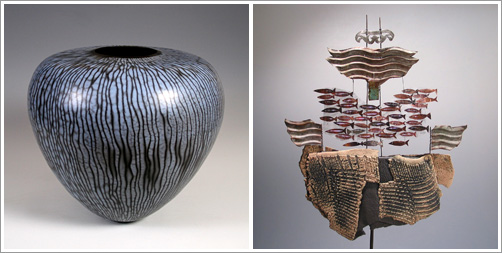
A visit to the Museum: Italian ceramics and much more…
The MIC – International Museum of Ceramics in Faenza – is reputed to be the world’s largest ceramic Museum and one of the liveliest art institutions in Italy.
Its collections provide the visitor with a complete overview of the history of Italian pottery and International ceramics, the evolution of pottery making techniques and the evolution of the visual ceramic art into figurative art, sculpture and design.
The collections encompass Italian ceramic works from the Middle Ages to the Present. A nice section displays the “functional” Italian pottery over time from the North to the South of the country: pieces molded for everyday use, whose features are strongly connected to their regional heritage.
Although Italian pottery is the core of the Museum’s holdings, most interesting collections from all over the world promote the understanding and appreciation of International ceramic art and history.
The Museum is namely proud to display important works from the Pre-Columbian America, the Classic Greece, the Roman Age, the Far and Middle East and the largest collection in Italy of Muslim and Hispano Moresque pottery. Continue reading ‘The International Museum of Ceramics in Faenza celebrates 100 years’
March 16 – June 30, 1008
Certaldo, Palazzo Pretorio
This is the Second Edition of a very successful exhibition, organized for the first time last year by the International Ceramic School La Meridiana and the Galleria Gulliver. It is held in Certaldo, a lovely town in Tuscany, not far from Florence and Siena.
The art works will be displayed in an outstanding location: the garden and the interior of Palazzo Pretorio, a very handsome building which could be in itself a reason for visiting Certaldo. The Palace is 1000 years old and it has been recently restored to its original condition. Its facade is richly decorated with ceramic coat of arms, two of them made by Della Robbia. In the interior there are beautiful frescoes by Benozzo Gozzoli.
No better location could be chosen to highlight the close relationship between Ceramic Art and the Tuscany countryside, a timeless source of inspiration for ceramic artists.
Continue reading ‘ConCreta 2008 – International Exhibition of Ceramic Sculpture’
March 29 – May 11, 2008
Brescia – Italy
Sartori’s works are “earthenware ideas”. They have mysterious origins and appear to be completely uninfluenced by his heritage, the artistic traditions of his land, his experiences.
Looking at his ceramic sculptures, the first impression one gets is that they belong to the earth they are made of , so strict is the relationship between the artifact and the material. Just as if time had stopped and the material had become solid.
His organic and abstract shapes, along with his figures are the key characters of Sartori’s creative themes, such as “Meteors” and “Geologic Echos”.
Continue reading ‘Bruny Sartori – Italian Art Pottery’
February 15 – April 19, 2008
Firenze – Italy
A solo exhibition will feature Tonina Cecchetti’s most recent works: large and small sculptures made of terracotta and coated in different materials.
The mother and child theme runs through each and every work with poetical intensity. Their “clothes” protect them but at the same time imprison them in an ambiguity or dilemma which is typical of Cecchetti’s art philosophy.
Iron, leather, wool and other recycled materials are matched to painted and glazed terracotta.
Tonina Cecchetti lives in Sigillo, not far from Gubbio in Umbria, where the tradition of pottery making is deeply rooted. Gubbio ceramics are very famous thanks to Mastro Giorgio’s lustres which are among the masterpieces of Italian Renaissance art heritage.
Galleria Varart
Via dell’Oriuolo, 47-49r, Firenze
Tel. +39 055 284265
varart@tin.it
February 16 – March 13, 2008
Mondolfo – Italy
In Luca Caimmi’s hands, traditional structures are re-invented. The subtle beauty of his works can be found in the balance of volume and shape. A shape inspired by a vase is not meant to contain something but to delimit the void.
His ceramics are white with silver details: the organic, earthly origin of the clay is thus hidden and forgotten. Time is frozen into eternity.
Galleria Pu-Ri’
Via XX Settembre 13
Tue/Sun: 10.00/18.00 – Thu: 10:00/22:00
Tel. +39 0721 957201
puricomunicazione@gmail.com
February 5 – May 11, 2008
St Petersburg - Russia
The awesome Italian majolicas from Castelli belonging to the Hermitage Fund have just returned to St Petersburg after a very successful tour in Italy.
The State Hermitage Museum will feature them in the Blue Bedroom of the Winter Palace until May 11th, 2008.
The Hermitage collection includes 77 works which were purchased in Italy by Russian art merchants on behalf of the Russian Tsars and other wealthy families between the 16th and the 17th century.
They had an excellent taste: they bought pieces painted by the most talented masters in Castelli, such as Carmine Gentile, Carlo Antonio Grue, Pompeo de Bernamonte, Orazio Pompei, Francesco Antonio Grue, Nicola Cappelletti.
Continue reading ‘Italian Ceramics from Castelli - State Hermitage Museum Collection’
January 23 – May 4, 2008
Bologna – Italy
One of the foremost Italian artists working today, Luigi Ontani (Italian, born in 1943) has redefined the image of the contemporary artist through his works. His installations, ceramic sculptures and tableaux vivants (living paintings) are a landmark in the history of performance art and photography.
Ontani describes his art as “the adventure I live as a person of art”.
As a matter of fact, he uses his own body as the medium for communication and by means of costumes and masks he assumes the fictional identities of his favorite heroes from mythology, fairytales, history and art history. He said: “I live this ambiguity with irony and aspiring to harmony. My art is the adventure I live on myself.”
As the subject of his art, Ontani can live art, create art, and express his love for art.
Continue reading ‘Luigi Ontani –MAMbo: Museo d’Arte Moderna di Bologna’
January 31 – March 8, 2008
Turin - Italy
“Effetti Personali” is an amazing exhibition. Laveri’s extra large Italian ceramic works are the eye-catching result of a new attitude of looking at and rethinking the simple objects that surround us and belong to our everyday routine.
Laveri highlights and provides with a new dignity the apparently meaningless things that cross our path everyday, without having the chance of being noticed.
Their role in our life is reversed: they become giant artworks, grab our attention, escape death through the miracle of the firing.
Continue reading ‘“Effetti Personali” – Contemporary ceramic works by Giorgio Laveri’
Latest Comments